Car commercial: what it sells, what must be exact, and where AI fits
What should a car commercial sell, and what must match reality? Formats for brands, dealers and used-car lots, Turkish fuel and CO2 rules, and a checklist.
Service AI commercials ·Watch the sample film
What does a car commercial sell?
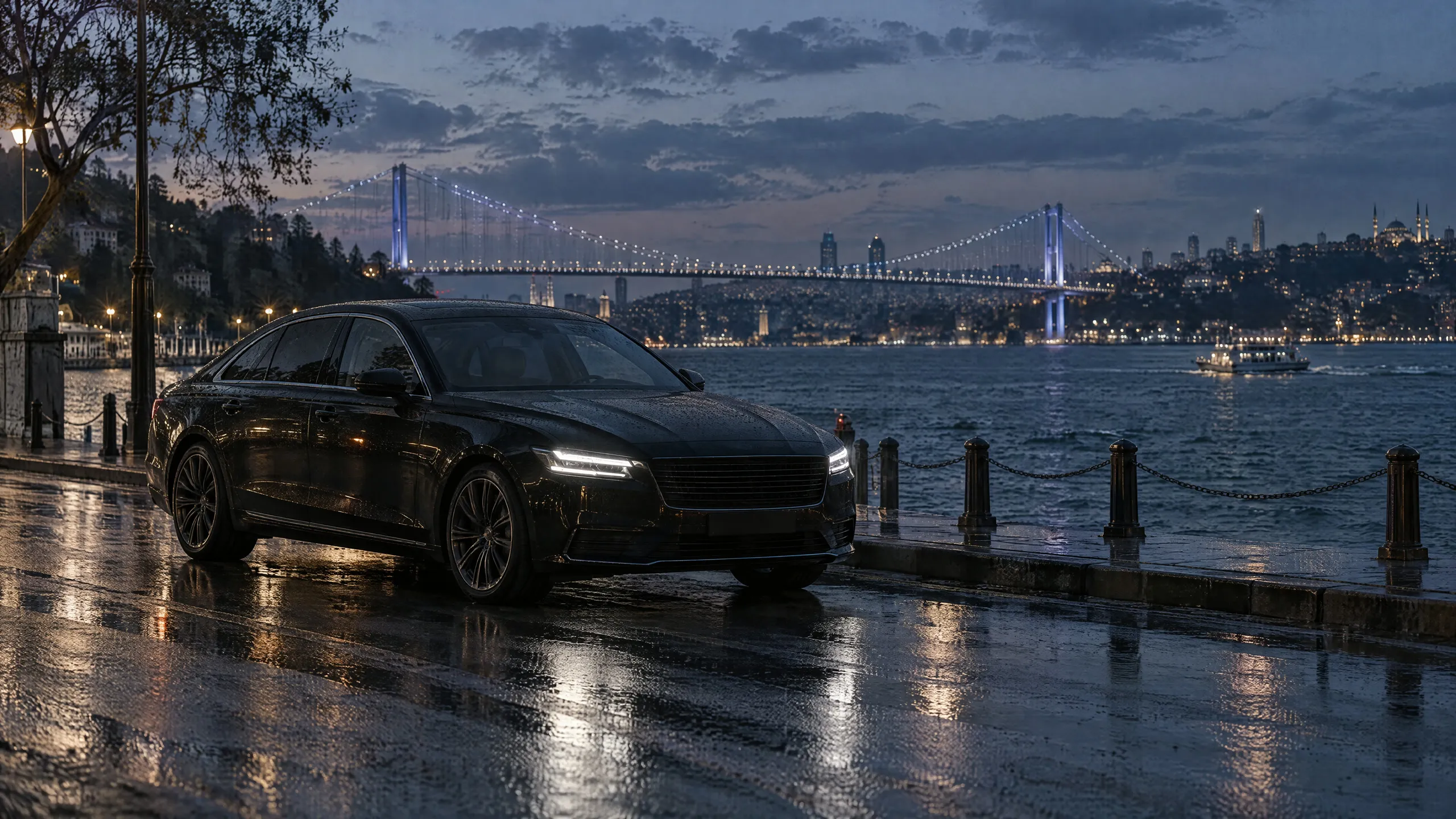
Nobody buys a car for horsepower alone. A good car commercial (or car ad, or dealership video) sells a feeling: a road leaving the city, lights sliding across wet asphalt, ten minutes alone behind the wheel. The specs live in the brochure and the showroom; the film shows what it feels like to be inside that car.
A strong car film has three parts:
- A road. City, coast, mountain; the place the car belongs.
- A light. Blue hour, sunrise, the night after rain. A car film is, to a large extent, a film about light and reflections.
- A moment. The first long drive, the ride home after midnight, an empty bridge.
An example: “Night”
Cinela’s automotive sample film, “Night”, is built on these three. It isn’t client work; it’s a study we made to test the method. In Istanbul just after the rain, an unbadged car makes a single night drive from Galata to the Bosphorus. The film doesn’t offer a list of features; the light, the wet streets and the road say what the car promises. Watch the film.
The car carries no badge; the film is a study of a method, not of a brand. With a real model, the rules change.
What has to match reality?
The line is clear: AI builds the world; it doesn’t invent the car.
| AI can build | Must match reality |
|---|---|
| Road, city and landscape | The model’s exterior and interior design: proportions, lights, wheels, colours |
| Weather: rain, fog, snow | Equipment: what comes with which trim |
| Night, blue hour, sunrise | Specs: range, acceleration, fuel consumption |
| Camera moves, rhythm, music | Price, offers, instalment and finance terms |
| Characters and story | What driver-assistance systems actually do |
It isn’t only about trust. The ICC Advertising and Marketing Communications Code says marketing should be truthful and not misleading. Turkish consumer law bans misleading advertising and puts the burden of proving claims on the advertiser. If your ad runs in Turkey, a few more rules apply:
- Fuel consumption and CO2. Turkey’s regulation on new passenger cars treats printed and other materials used to advertise and promote cars as “promotional literature”, and requires them to carry the model’s official fuel consumption and CO2 emissions data. The data must be legible and no less prominent than the main information. Material that refers only to a brand, not to a model, doesn’t need fuel consumption data. The regulation was prepared in line with EU Directive 1999/94/EC, so the logic will be familiar to brands that advertise in the EU.
- Instalments and on-screen text. An ad that gives an instalment amount must also show the total price and the number of instalments at a legible size, or say them aloud. On-screen text must be legible in size and speed.
- Safe driving. Ads may not show dangerous situations where safety rules are ignored. Making a car speed through the city at night with AI is easy; publishing it isn’t.
- AI disclosure. Since 1 August 2026, ads that feature AI-made characters indistinguishable from humans must say so clearly. Showing an AI-made copy of a real person falsely using or recommending the car is banned.
Used-car dealers in Turkey have a further regulation on motor vehicle trade: listings must carry the dealer’s authorisation certificate number and business name, plus up-to-date details such as mileage, repainted and replaced parts, damage record and price.
In practice, two layers work together: the car itself rests on the brand’s approved imagery or on real footage; the road, the weather and the night are built with AI. Cinela uses brand assets only with their owner’s permission and delivers every film clearly labelled as AI-made. This article isn’t legal advice; check campaign copy with your legal counsel.
Brand, dealer or used-car lot: which film for whom?
| What they need | Best format | Watch out for | |
|---|---|---|---|
| Brand and distributor | Model launch, brand image | 30 s master film; 16:9, 9:16 and 1:1 cuts | Official specs, fuel and CO2 data |
| Franchised dealer | Offer periods, test drives, service | Short vertical videos, an offer cut | The brand’s identity guidelines, up-to-date prices |
| Used-car lot | Trust, local presence, experience | A short film about the dealer and a vertical series | Every car for sale shown in real photos and video |
For a used-car lot, the efficient route also has two layers. The film about the dealer itself, why people should buy from you, can be built with AI. Every car on sale is shown as it is, in real footage. For hooks and editing in vertical cuts, see our Reels ad video guide; for separating the product from the atmosphere, read the product video guide.
Timeline and budget
A traditional night-time road shoot needs a set, a crew, road permits and a spare day for the weather; it usually takes 4–8 weeks. With AI none of that is needed, and changes are made frame by frame on the same day, not with a reshoot.
For the vertical needs of dealers and used-car lots, Cinela’s Social Series package fits: $990, 3 vertical videos × 15 s, 5 business days. For a brand film, the Commercial package is $1,990: a 30 s film; 16:9, 9:16 and 1:1 cuts; original score and sound design; 2 revisions; full usage rights; 7 business days. Prices exclude VAT. The process starts with a brief of about 20 minutes; the script, a frame for every scene and the edit follow in order. No step goes ahead without your approval. Details are on our AI commercials page.
A checklist before the brief
- What feeling does the film sell? Write it in one sentence.
- Which model, which trim? Is every detail in the film part of that trim?
- Who signs off the specs and price? Are the source and date clear?
- How will fuel and CO2 data be shown? If a new model is named, settle it in the brief.
- Are you mentioning instalments or finance? Are the total price and terms legible?
- Is the driving safe? Speed, seat belts, traffic rules.
- Are permissions and labels in place? Brand approval for logo and design, and an AI disclosure in the film.
A one-sentence idea is enough; write to us through the quote form.
Sources
Sources were checked in October 2026; see each source for the current text.
- ICC Advertising and Marketing Communications Code (2024), Article 5
- Turkish Consumer Protection Law No. 6502, Article 61 (in Turkish)
- Turkish Regulation on Consumer Information on Fuel Economy and CO2 Emissions of New Passenger Cars, Articles 4, 8, 14 and Annex IV (in Turkish)
- Turkish Regulation on Commercial Advertising and Unfair Commercial Practices, Articles 5, 13 and 18 (Official Gazette, 10 January 2015, in Turkish)
- Amendment to the Regulation on Commercial Advertising and Unfair Commercial Practices (Official Gazette, 1 July 2026; in force 1 August 2026, in Turkish)
- Turkish Regulation on Motor Vehicle Trade, Articles 20 and 21 (Official Gazette, 27 August 2024, in Turkish)
- Car commercial
- Commercials
- Regulation
- AI video
More articles
All articles →-

What is a brand film? How it differs from an ad, its structure and cost
What is a brand film, and how does it differ from a commercial, corporate video or branded content? How a good one is built, where it's used, and cost.
Read -
How to write a commercial script: format, structure and an example
How to write a commercial script: the two-column format, a 30-second structure, an original example script, voice-over rules, common mistakes and a checklist.
Read