How to write a commercial script: format, structure and an example
How to write a commercial script: the two-column format, a 30-second structure, an original example script, voice-over rules, common mistakes and a checklist.
Service AI commercials ·Watch the sample film
What is a commercial script?
A commercial script is the written version of a commercial: it says what will be seen in each second, what will be heard and which text will be on screen. The idea is a single sentence; the script is how that sentence is told, second by second.
The script sits between the brief and the storyboard. The brief says what you want to say, to whom and why; the script builds the story; the storyboard shows that story frame by frame. We cover briefs in our creative brief guide and storyboards in what is a storyboard.
The commercial script format: two columns
A feature film script is written page by page, with scene headings and dialogue. A commercial script is usually a two-column table, often called an AV (audio-visual) script.
| Column | What goes in it |
|---|---|
| Time | The seconds a row covers: 0–3 s, 3–8 s |
| Picture | What do we see? Place, person, action, shot size |
| Sound | Voice-over, dialogue, music, sound effects; “silence” if there’s none |
| On-screen text | Tagline, logo, legal copy, subtitles; a separate column if needed |
The format has two advantages. With picture and sound side by side, you can see which of them carries the story. And the time column shows on first reading whether the film fits its target length.
How do you structure a 30-second commercial script?
Every film is different, but this four-part skeleton is a good starting point for a 30-second ad:
| Part | Roughly where | Job |
|---|---|---|
| Opening | First 3 seconds | Grab attention: a sound, a question, an unexpected image |
| Build-up | 3–15 s | Set up the person and the situation; a wish or a problem |
| Turning point | 15–25 s | A decision, a surprise, a change |
| Ending | Last 5 seconds | Product, brand and a single line |
These timings are a starting point, not a rule. In a vertical cut the opening moves even earlier; something has to happen in the first second.
Types of commercial script: which approach when?
Look at enough commercial script examples and the same few approaches keep coming back. The right one depends on the product, the audience and the length of the film.
| Approach | How it works | When it fits | Watch out |
|---|---|---|---|
| Story | A person, a wish, a turning point | When you want emotion and a bond with the brand | The product must find a natural place in the story |
| Problem and solution | A familiar problem first, then the product | When the product solves a specific pain | Don’t exaggerate the problem; viewers should recognise themselves |
| Demonstration | The product at work: before and after | When the difference is visible | The result shown must be real; the advertiser has to prove the claim |
| Rhythm and music | Short shots, strong music, few words | Vertical feeds and launch cuts | The idea still has to fit in one sentence |
| Testimonial | A real customer or expert speaks | When trust comes before the product | The person and the experience must be real; never recreated with AI |
In Türkiye, advertisers have to prove the claims in their ads, and that burden is most visible in demonstration and testimonial scripts. Since 1 August 2026, ads in which an AI-made digital copy of a real person falsely appears to have used or to recommend a product are also banned.
An example commercial script: “The Second Glass”
The script below was written for this article: a 30-second film with no dialogue for a fictional tea brand.
Idea: An old man who lives alone hands the second glass to the new neighbour who has just moved in across the landing.
| Time | Picture | Sound |
|---|---|---|
| 0–3 s | Morning, a plain kitchen. A kettle boiling on the stove. | The kettle’s whistle. No music. |
| 3–8 s | Close-up: an old man takes two tulip-shaped tea glasses from the cupboard, pauses, puts one back. | The clink of glass, then silence. |
| 8–14 s | The building’s corridor. A young woman moving into the flat opposite, arms full of boxes, searches for her key at the door; a box drops. | The thud of the box, the distant hum of the city. |
| 14–19 s | The man opens his door a crack and looks. He goes back in and takes the second glass out of the cupboard again. | A single piano note; the music begins. |
| 19–26 s | The landing. The man at the door with two glasses of tea. The woman is surprised, smiles, sits on one of the boxes and takes the glass. | Music; a spoon clinking against glass. |
| 26–30 s | Two glasses side by side on a table, and the pack of tea. Logo. | Voice-over: “A glass of tea, a neighbour.” |
Why it works
- The opening is a sound. The kettle’s whistle pulls the viewer into the kitchen before the picture does.
- The turning point is a single gesture. The glass that went back into the cupboard comes out again; the decision is seen without a word.
- The product is in the story from the start. Tea is in every scene; the pack only appears in the last frame.
- The voice-over is one line. It doesn’t repeat what the picture says; it gives it a name.
To cut the same script to 15 seconds, shorten the corridor scene and take the man’s decision straight to the landing. In the vertical cut, the first shot could be a close-up of the two glasses rather than the kettle.
How much voice-over and on-screen text?
There’s less room for voice-over in a 30-second film than people think. Music, silence and room for the picture to breathe all take time. A simple test: read the voice-over aloud with the picture, at a natural pace, and time it with a stopwatch. If it doesn’t fit, cut words; don’t speed up the read.
The same principle applies to on-screen text: short enough to read, and on screen long enough to be read. If there’s legal copy (campaign terms, credit information and so on), reserve its place in the script from the start; text squeezed into the end goes unread.
We cover how much story fits into each length in our commercial length guide.
Common commercial script mistakes
| Mistake | Why it hurts | Instead |
|---|---|---|
| A list of features | Viewers remember none of them | Show one feature through one moment |
| Voice-over repeating the picture | Wastes time and talks down to viewers | Save the voice-over for what the picture can’t say |
| Logo on screen throughout | It gets in the way of the story | Put the product inside the story and the logo at the end |
| Three calls to action | “Visit, download, follow” gets none of them done | Pick one action |
| Finding out the length in the edit | The best scenes get cut | Read the script aloud and time it from the start |
| Adding a speaking character’s lines later | Mouth and voice don’t match | If someone speaks, write the dialogue into the script |
Why the script matters even more with AI
On a traditional shoot, the director, actors and cinematographer fill the gaps in a script on set. In AI production there is no set; every shot is generated from the script and the shot list. Every ambiguity in the script turns into a guess in production. That’s why a clearly written script is the most important input to AI production.
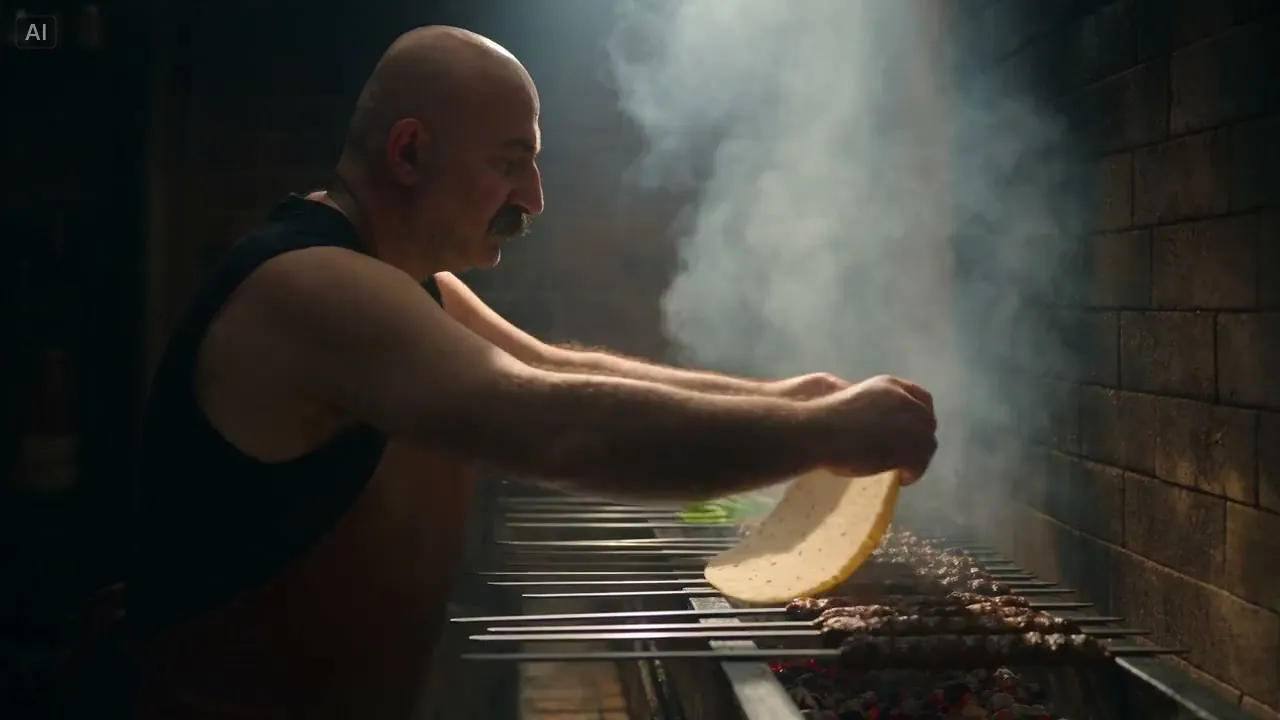
The cover of this article is a frame from Fire, Cinela’s food and drink sample film. It also rests on a script without dialogue, and each shot carries a single action: the fire growing, meat pressed onto the skewer, flatbread laid over the skewers, service on a copper tray. It isn’t client work; it’s one of Cinela’s own studies. Watch Fire.
At Cinela the script and shot list come to you for approval on day 2; you read, fix and approve. Then a frame for every scene is made on days 3–4, and music, sound, edit and delivery follow on day 5. No step goes ahead without your approval, and the script is included in the package price.
A checklist before you send it
- Does the idea fit in one sentence?
- Is there something in the first 3 seconds that grabs attention?
- Is there a turning point?
- Does every row have a timing, and does the total match the target?
- Has the voice-over been read aloud and timed?
- Where does the product appear, and for how long?
- Is there a single action at the end?
- Is space reserved for legal copy and on-screen text?
- Have the 15-second and vertical cuts been considered?
If you want to turn a finished script, or an idea that’s still one sentence, into a film, a 30-second commercial starts at $1,990 (excl. VAT) and is delivered in 7 business days, with script, original score and three formats included. Details are on our AI commercials page.
Sources
The rules were checked in November 2026; see the sources for the current text.
- Commercial script
- Commercials
- Example script
- Checklist
More articles
All articles →-
What is a brand film? How it differs from an ad, its structure and cost
What is a brand film, and how does it differ from a commercial, corporate video or branded content? How a good one is built, where it's used, and cost.
Read -
What is a PSA? How a public service announcement differs from an ad
What is a PSA, and how does it differ from a commercial? Topics and formats, the rules of a good public service announcement, broadcast rules and AI production.
Read